
Understanding Light Quality
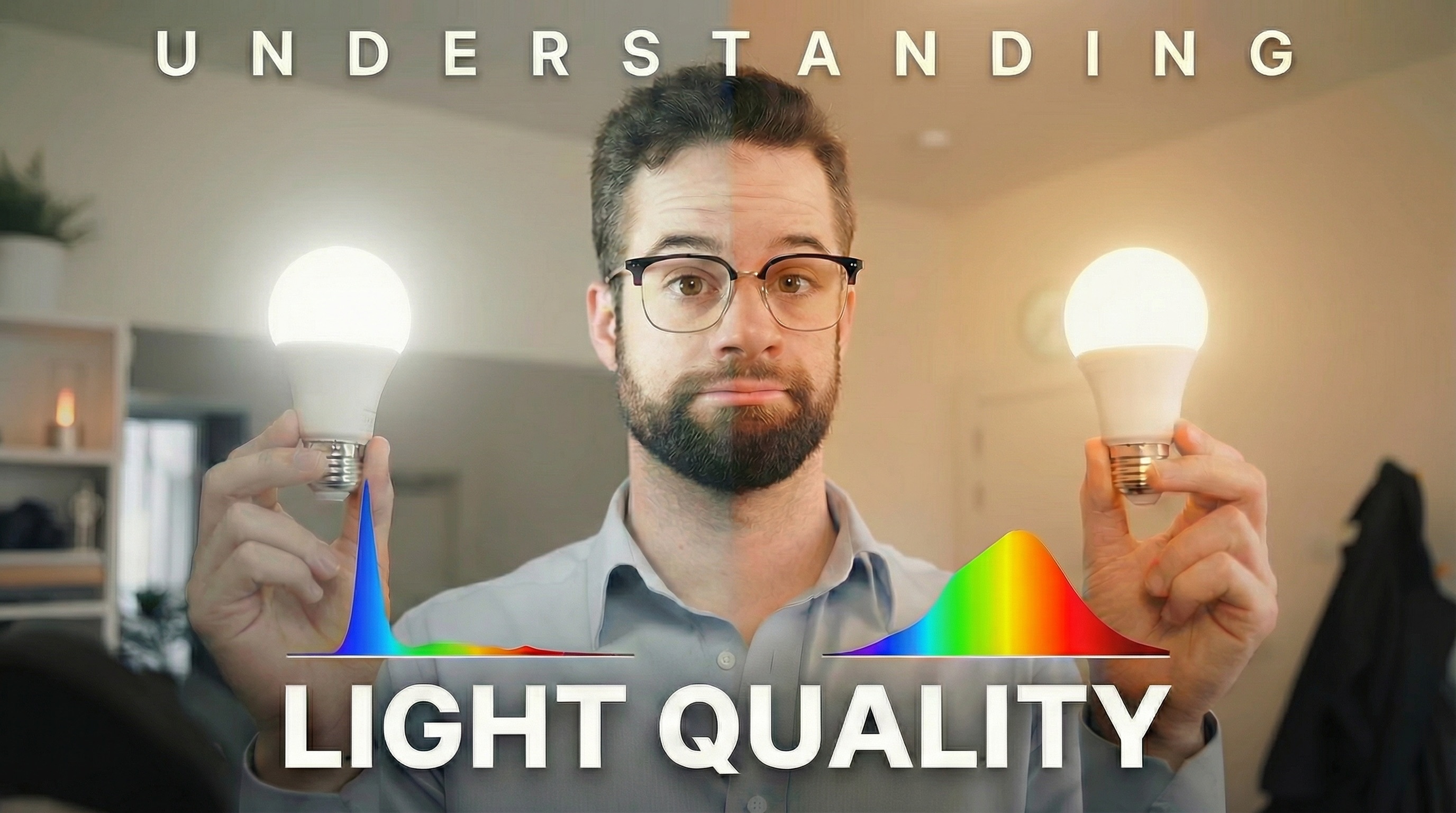
A Complete Guide to Light Quality That Will Change How You See Every Room
You know that feeling when you step outside on a sunny day and something just clicks? Your body relaxes, colors look vibrant, and you feel… awake. Properly awake.
Now think about the last time you felt that way under artificial light.
Yeah. Me neither.
For most of my life, I thought light was simple: there’s bright and dark, warm and cold. Maybe you know the Kelvin scale — 2700K is cozy, 5000K is clinical. That’s basically it, right?
Turns out there’s an entire hidden dimension to light that nobody talks about. And once you understand it, you’ll never look at a room the same way again.
The Problem Nobody Sees
Here’s something wild: two lights can look exactly the same to your eyes, but one makes you feel alert and happy while the other gives you headaches and messes with your sleep. This isn’t placebo. It’s physics.
There’s actually a word for this — metamerism. It means different light spectrums can appear identical to our eyes while being fundamentally different in composition.
Your eyes might say “this is a nice warm white,” while your body is being blasted with hidden blue light that’s telling your brain it’s high noon. Or a light can look perfectly steady and calm while actually flickering hundreds of times per second, keeping your nervous system on edge.
This is what low-quality light does to us. We don’t notice it consciously. But we feel it.
What’s Actually In Your Light
To understand light quality, we need to talk about the spectrum — the actual wavelengths of light that a source emits.
When you look at white light, you’re not seeing a single thing. You’re seeing a mixture of all the colors of the rainbow combined. But how they’re combined makes all the difference.
Sunlight has a beautifully smooth, continuous spectrum. It contains every wavelength in relatively even proportions. This is what our biology evolved under for millions of years. This is “correct” light, as far as your body is concerned.
Incandescent bulbs are actually pretty good. They work like tiny suns — a hot filament glowing with a smooth spectrum. The catch? Most of their energy goes into infrared (heat) rather than visible light. That’s why they’re inefficient, but it’s also why they feel so natural.
Fluorescent lights are chaos. Their spectrum looks like a heart rate monitor during a panic attack — random spikes at certain wavelengths with gaps everywhere else. Your body doesn’t love this.
LEDs are where it gets interesting. Most white LEDs are actually blue LEDs with a phosphor coating that converts some of the blue light to other colors. The result? A spectrum with a massive blue spike and a hump of other colors. Even if the light looks warm, there’s often way more blue in there than you’d expect.
This matters because of something called…
The Receptors You Didn’t Know You Had
You probably know your eyes have three types of color receptors: red, green, and blue cones. Together, they let you perceive the full rainbow of visible colors.
But there’s a fourth player that nobody tells you about: ipRGCs (intrinsically photosensitive retinal ganglion cells). These contain a protein called melanopsin, and they don’t help you see anything. Instead, they tell your body what time it is.
Here’s the kicker: melanopsin is most sensitive to blue light, specifically wavelengths between 460-480 nanometers.
When these receptors detect lots of blue light, they signal your brain to suppress melatonin production. Translation: you stay awake and alert. This is fantastic at 10 AM. It’s terrible at 10 PM when you’re trying to wind down.
So that warm-looking LED with the hidden blue spike? Your eyes see “cozy evening light” but your ipRGCs see “it’s the middle of the day, stay alert!” No wonder you can’t sleep.
The Flicker You Can’t See (But Your Body Can)
There’s another invisible problem with modern lights: flicker.
Many LED lights dim using a technique called PWM (Pulse Width Modulation). Instead of actually dimming the light, they turn it on and off really fast. At 50% brightness, the light is fully on half the time and fully off the other half. Your eyes average this out and perceive it as dimmer.
Clever, right? Your nervous system disagrees.
Even when flicker is too fast to consciously see, your body still responds to it. Research shows that flickering lights contribute to:
- Headaches and migraines (people prone to migraines are about 4x more likely to get one under flickering light)
- Eye strain and fatigue
- Difficulty concentrating
- General unease (that feeling that something is “off” about a space)
You can actually test for flicker yourself: point your phone camera at a light and look at the screen. If you see dark bands or stripes moving across the image, that light is flickering. Your camera is capturing what your conscious mind can’t see — but your nervous system definitely notices.
For reference, flicker above 3000 Hz is considered safe. Flicker below 100 Hz can be problematic. Many cheap LED bulbs, especially when dimmed, flicker at around 100-120 Hz. Not great.
Why CRI Is Lying to You
Now let’s talk about how light quality is measured, because this is where things get frustrating.
The standard metric is CRI (Color Rendering Index). It measures how accurately a light reproduces colors compared to a reference source (sunlight or incandescent, depending on color temperature). The scale goes from 0-100, where 100 means perfect accuracy.
You’ll often hear that CRI 80 is “good” and CRI 90+ is “excellent.”
I disagree. Here’s why.
CRI is calculated using only 8 test colors — and they’re all muted pastels. Look at them. There’s no vibrant red. No deep blue. Just soft, safe, easy-to-reproduce colors.
This means a manufacturer can optimize their LED to score great on those 8 specific pastels while completely butchering other colors. You end up with a light that has CRI 90 on the box but makes everyone look vaguely ill because it can’t render skin tones properly.
The most important color that CRI ignores? Deep red.
This is where the extended CRI values come in, particularly R9 — the saturated red test. Many LEDs with impressive CRI scores have R9 values that are embarrassingly low, sometimes even negative. And red is everywhere: skin tones, food, wood, brick, autumn leaves.
If I’m looking at a light’s specs, I’ll take a CRI 85 with R9 of 90 over a CRI 95 with R9 of 20 any day.
Here’s another plot twist: we don’t actually want perfect accuracy. Studies show that humans prefer light that slightly enhances red saturation. We like things a bit more vibrant than they technically “should” be. But this preference actually lowers your CRI score because you’re deviating from the reference.
So you could have a light that people love, that makes colors pop beautifully, that scores worse on CRI than a light that makes everything look flat and lifeless.
The system is broken.
TM-30: The Better Standard Nobody Uses
There is a better measurement system. It’s called TM-30, developed by the Illuminating Engineering Society.
Instead of 8 pastel samples, TM-30 uses 99 colors spanning the entire spectrum, including proper saturated reds and blues. It also measures two dimensions:
- Rf (Fidelity): How accurate are the colors? (0-100, like CRI)
- Rg (Gamut): How saturated do colors appear? (100 = same as reference, >100 = more saturated, <100 = more muted)
TM-30 also includes a beautiful vector graphic that shows you exactly which colors are enhanced or diminished and in which direction.
The problem? TM-30 testing is expensive, and there’s been industry lobbying to keep it optional. So most lights you’ll find in stores only show CRI, if they show anything at all.
When you do find TM-30 data, you can actually see whether a light will make your space look alive or washed out. It’s a game-changer.
What to Actually Look For
Alright, practical advice time. Here’s what I look for when buying lights:
For general quality:
- CRI 95+ (as a baseline, not a guarantee)
- R9 specifically: 90+ is excellent, 50+ is acceptable, below 50 is a red flag (pun intended)
- TM-30 data if available: Rf 95+ and Rg between 97-103 is the sweet spot
For avoiding flicker:
- Look for “flicker-free” claims
- DC dimming is better than PWM dimming
- Test with your phone camera before committing
For circadian health:
- Daytime: Higher color temperature (4000-5500K) with good intensity to keep you alert
- Evening: Warm white (2700K or below) with no hidden blue spike
- Night: Really warm (1800-2000K) and dim — think candlelight
And honestly? The light bulb database (where people with spectrometers test real products) is worth its weight in gold. Real measurements from real lights, showing spectrums, CRI, R9, flicker — everything.
Setting Up Your Home
The ultimate goal is to make your artificial lighting work with your biology instead of against it.
During the day: Bright and cool. You’re never going to match actual sunlight (100,000 lux outside vs. maybe 500 inside), but you can at least try. High-quality, high-intensity light in your face keeps you alert. Even better: get outside.
During the evening: Warm and dim. You want lights that are actually warm — not “looks warm but secretly blue” warm. I personally go warmer than the standard 2700K recommendation. Think firelight. Think candles. 1800-2000K if you can find it.
The position trick: In the evening, place your lights low. We’re hardwired from millions of years around campfires. Overhead lighting at night feels unnatural because it is.
Automation: If you use Home Assistant, there’s an integration called Adaptive Lighting that automatically adjusts your lights based on sun position and time of day. It’s not perfect, but it means your lights are roughly correct most of the time without you having to think about it.
The Rabbit Hole
I’ll be honest: once you understand all this, you’ll start noticing bad lighting everywhere. Offices. Stores. Restaurants. Your own home.
I ended up at the point where I’m building my own lights because I couldn’t find commercial products that met all my criteria — high CRI, excellent R9, proper warm whites, no flicker, and smart home controllable.
It’s a journey.
But even if you don’t go full DIY, just knowing what to look for will help you make better choices. Check the R9. Look up lights in the database. Test for flicker. Choose warmth in the evening.
Your eyes might not consciously notice the difference.
But you will feel it.
The light you surround yourself with literally shapes how you see the world, how you feel, and how well you sleep. It’s worth getting right.